
Quality Report 2025
The Year 2025 of the National Digital Preservation Services in Finland
General
Digital preservation services (DPS) refer to services provided for the digital preservation of cultural heritage content and research data. The development of DPS is continuous and takes place in close cooperation with the partner organizations. The aim is that the most significant digitalized cultural heritage content, and content created in digital form, in the Digital Preservation Service for Cultural Heritage will be preserved for future generations and the long-term use of the content will be possible. Similarly, the Digital Preservation Service for Research Data ensures the availability and preservation of digital research data. Both services use a shared digital preservation system for bit-level preservation.
The Digital Preservation Service for Cultural Heritage started preserving content in 2015, and the Digital Preservation Service for Research Data in late 2019. Organizations that use the Digital Preservation Service for Research Data for preparing and storing content can also make more extensive use of Fairdata services, including the packaging service and the management interface.
The Main Results of the Year 2025
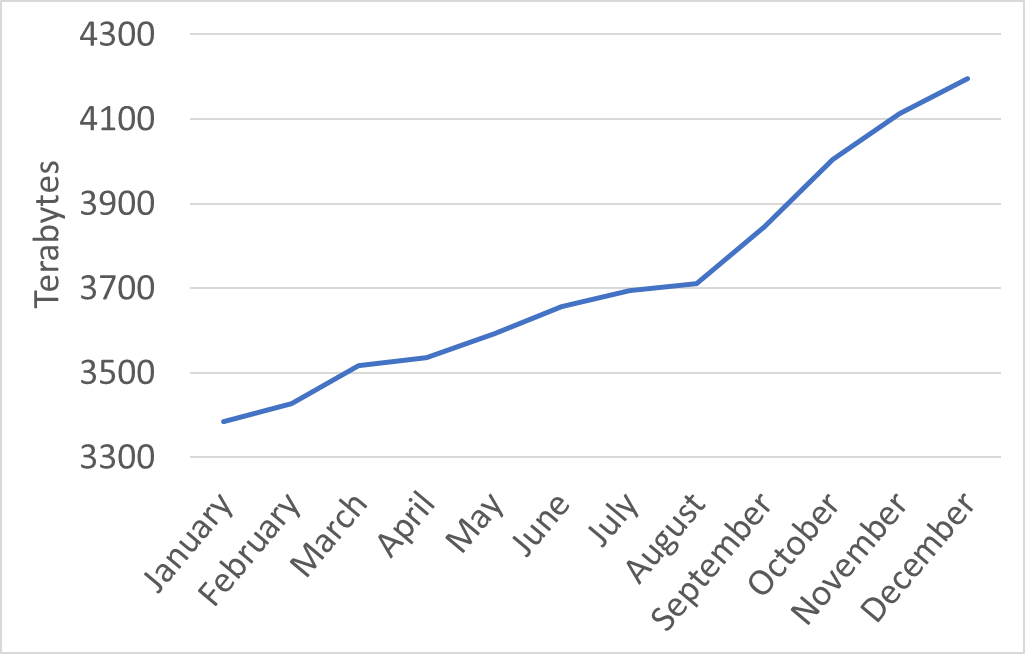
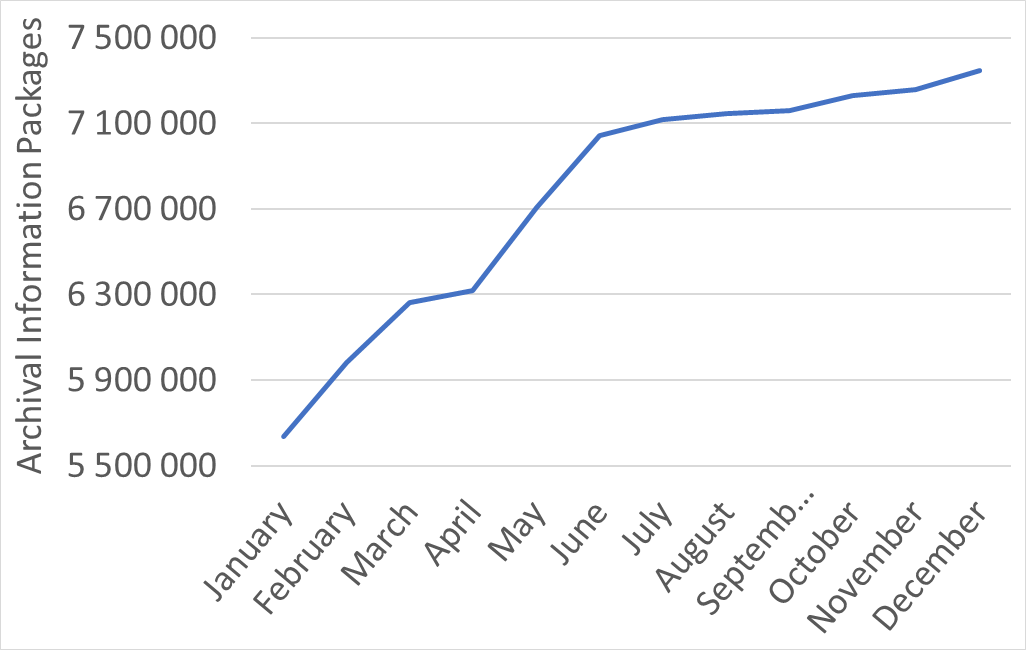
In 2025, the annual growth rate of stored data was 849 terabytes, a new record in the history of the DPS. More than 1,770,000 new Archival Information Packages (AIPs) were collected for preservation. The amount of material in preservation exceeded 4 petabytes by the end of 2025.
No changes were made to the storage capacity of the DPS in 2025 and it is still 7.5 petabytes.
The use of the Digital Preservation Service for Cultural Heritage in the museum sector was strengthened during 2025 by new commissionings and, among other things, by presenting the service in the TAKOTech network of museums. Integration with the DPS was implemented through a background system widely used in museums and private archives, which will facilitate the implementation of the DPS by these organi<ations in the future. The increase in the amount of data in the research data is ensured by a new and large preservation agreement of 700 terabytes, the technical implementation of which was completed during the year.
A register was published to support the partner organizations to investigate file format validation errors and to offer suggestions for solutions to the organizations. The register is collected based, among other things, on contacts with the DPS support. With the help of the register, previously formed solutions can be easily reused.
During 2025, long-term preservation of e-mail materials was successfully planned as a national collaboration. As a result of fruitful cooperation, e-mail materials have been added to the specifications to be published in 2026 as a new type of material. During 2025, the DPS also moved to a continuous and more open evaluation process of file formats, which enables the organizations that make use of them to more clearly influence the technical evaluation of the long-term preservation material, bringing significant aspects of the process of using the material. Continuous assessment also brings flexibility to the process, serving the continuity planning of organizations that make better use of their own.
A key result of software development is the planning of preparedness by adding automatic vulnerability scans to software development processes. As the base of the software code exceeds ten years of age, automatic scans keep the code base high quality and safe. In order to improve usage, the interfaces of the DPS were significantly renewed and the Digital Preservation Service for Reserach Data implemented extensive integration with the renewed interface of the Metax metadata repository.
The international perspective was highlighted in the DPS by participating, together with the National Library, in the biggest conference of the year in the field of long-term preservation iPRES 2025 in New Zealand. The DPS were featured every day of the conference, taking part in a total of five performances. In addition, Service Manager Juha Lehtonen was elected as a member of the Board of Directors of the Open Preservation Foundation.
To mark the 10th anniversary of the DPS, a seminar was organized in cooperation with the Ministry of Education and Culture. Approximately 120 people attended the seminar and the seminar received very good feedback.
A customer satisfaction survey for the digital preservation collaboration group was carried out at the end of 2025. Satisfaction with the DPS was quite positive (5.4/6).
Partner Organizations
| Organization | Purpose of use | Capacity (TB) |
|---|---|---|
| Amos Rex | Museon mediateoskokoelma | 1 |
| Celia | Master-arkisto ja pitkäaikaisesti säilytettävät valitut uudet äänikirjat | 160 |
| EMMA – Espoon modernin taiteen museo | EMMAn kokoelmien mediataide | 19 |
| Kansallinen audiovisuaalinen instituutti | Valikoitu osa kotimaisen elokuvan digitoitavista aineistoista | 3400 |
| KAMU Espoon kaupunginmuseo | KAMU Espoon kaupunginmuseon kulttuuriperintöaineistot | 9 |
| Kansallisarkisto | Kansallisarkiston pitäkaikaissäilytettävät aineistot | 987 |
| Kansallisgalleria | Kiasman mediataiteen teosten pitkäaikaissäilytys | 50 |
| Kansalliskirjasto | Kansalliskirjaston digitoimat kulttuuriperintöaineistot | 1083 |
| Kansalliskirjasto | Kulttuuriaineistolain nojalla kerätyt aineistot | 575 |
| Kotimaisten kielten keskus Kotus | Kotuksen kielentutkimus- ja kulttuuriperintöaineistojen pitkäaikaissäilytys | 60 |
| Museovirasto | Kulttuuriympäristön tutkimusraportit | 1 |
| Musiikkiarkisto | Musiikkiarkiston pitkäaikaissäilytettävät aineistot | 70 |
| Postimuseo | Postimuseon filateelisen kokoelman pitkäaikaissäilytys | 2 |
| Suomen rautatiemuseo | Suomen rautatiemuseon kokoelmat | 6 |
| Svenska Litteratursällskapet SLS | SLS:n pitkäaikaissäilytettävät aineistot | 50 |
| Yhteiskuntatieteellinen tietoarkisto, FSD | Tietoarkiston arkistoimien tutkimusaineistojen kokoelman pitkäaikaissäilytys | 1 |
| Organization | Purpose of use | Capacity (TB) |
|---|---|---|
| Geologian Tutkimuskeskus | GTK:n tomografialaitteen tuottamat tietoaineistot | 16 |
| Geologian Tutkimuskeskus | Röntgenfluoresenssi-kuvantamislaitteen tuottamat tietoaineistot | 2 |
| Helsingin yliopisto | Helsingin yliopiston SMEAR-aineistojen valikoima meteorologisia - ja ilmanlaatumittauksia | 2 |
| Helsingin yliopisto | M. cinxia and C. melitaearum in the Åland metapopulation system | 2 |
| Helsingin yliopisto | FIRE (The Finnish Reflection Experiment) | 1 |
| Helsingin yliopisto | Luomuksen aineistot | 150 |
| Helsingin yliopisto | Suomalaiset hautajaiset Covid-19-epidemian aikana | 1 |
| Itä-Suomen yliopisto | SENSOTRA | 1 |
| Jyväskylän yliopisto | Lifeplan Biodiversity Sound and Image Data | 700 |
| Jyväskylän yliopisto | Sodan sumusta -tutkimushaastattelut (2023-2024) | 1 |
| Jyväskylän yliopiston kiihdytinlaboratorio | 250-Nobeliumin hajoamisspektroskopia | 1 |
| Oulun yliopisto | Yksilöllisesti merkittyjen hömötiaisten pitkäaikaisseuranta-aineisto | 1 |
| Oulun yliopisto, Sodankylän geofysikaalinen observatorio | Havaintoaineistot | 30 |
| Tampereen yliopisto | Kansanperinteen arkiston Yleiskokoelma | 5 |
| Tampereen yliopisto | Yhteiskuntatieteiden tiedekunnan Kansanperinteen arkiston A-K-kokoelma | 2 |
| Turun yliopisto | Historian, kulttuurin ja taiteiden tutkimuksen arkiston aineistot (HKT-arkisto) | 20 |
| Åbo Akademi | Samlingar vid Åbo Akademis bibliotek | 10 |
Data Accumulation in 2025
During the year, approximately 849 terabytes of new materials were received for preservation, and at the end of 2025, the total amount of material in preservation was over 4.1 petabytes. The data collection during 2025 is shown in the figure below.
In 2025, the DPS assumed responsibility for preserving for more than 1,770,000 material packages and at the end of 2025, there were more than 7,340,000 material packages in preservation. The accumulation of data packages during 2025 is shown in the figure below.
Digital Preservation Services and Sustainability
The annual carbon footprint of the DPS has been updated. The storage capacity of the DPS is 7.5 petabytes and the annual carbon emissions generated in accordance with the life cycle of its infrastructure are 21169 kg CO2 eq. This can also be represented as carbon emissions scaled to terabytes and in this case it is about 3 kg CO2 eq.
The DPS will have a life cycle of at least 7 years in accordance with the 2025 policies. Due to the increase in storage capacity over the years, the infrastructure has components of different ages. Now, the oldest components are six years old, and there is as yet no increased risk of material preservation being compromised by their aging. The DPS closely monitor the condition of the infrastructure and respond in a timely manner when there is evidence that infrastructure renewal is timely.
The DPS actively participated in the Carbon Footprint Task Force of the Digital Preservation Coalition. The activities of the working group include the calculation and management of the carbon footprint of long-term preservation.
Maintenance of the Digital Preservation Services
A wide range of actions is needed to provide digital preservation services:
- maintenance tasks,
- method and model development,
- software and hardware infrastructure, and
- administrative work.
The following section focuses especially on the maintenance tasks of the DPS based on the model for quality reporting on IT services’ production operations, in which the actual production over a certain period of time as well as incidents and recovery from them are typically stressed.
The main objectives of maintaining the Digital Preservation Services are:
- ensuring the integrity and availability of AIPs,
- monitoring the functioning of the services, and
- supporting organizations in using the DPS (incl. fixing invalid or incomplete Submission Information Packages (SIPs) detected during ingest).
Monitoring of the Digital Preservation Services
The monitoring of the DPS has been automated as far as possible. This control provides status and event information, not only for the maintenance of the services but also for the partner organizations, enabling experts to infer the status of the services and take the necessary action.
Currently, the following are automatically monitored in the DPS:
- hardware failures (including faulty hard drives),
- faulty tape drives,
- server availability,
- disk area fill rate,
- visibility of distributed storage areas on different servers,
- up-to-date status of the virus check database,
- storage layer integrity,
- availability of tape libraries,
- SSL certificate life cycles, and
- failed login attempts of SFTP port on fronted servers.
Manual monitoring additionally covers:
- progress of the job queue in the ingest,
- processing of SIPs stuck in the job queue,
- checking of AIP integrity,
- analyzing problems associated with rejected SIPs,
- replicating faulty media, and
- creating dark archive copies.
As part of efforts to develop the DPS, monitoring of the services is also being improved and new processes will be automated. This will enable cost-effective maintenance of the services while the volume of content to be preserved increases.
Quality Deviations Relating to Preserved Content in 2025
During the year, there was one breakdown of the SAN switch, four plate breaks, seven failed tape drives, and two faulty memory modules. In addition, backup battery of two RAID controllers were replaced. In addition to these, a single port was observed to have gone down in the SAN network. An error occurred in the storage of 25 AIPs due to the failure status of the tape drive, but the intact versions of the packages were saved with another tape drive.
A faulty LTFS file system was detected on one tape, after repair, a lack of two AIPs was detected on the tape, which were restored. Four corrupt AIPs were detected during the fixity check of the tapes, of which new copies were made.
New Features of Software Development
In the DPS, the transfer of content to the DPS was renewed to use the HTTP protocol. This will enable more diverse tracking of transfers in the future and will make it easier for partner organizations to manage their content sent for preservation. During 2025, the software development of the DPS focused significantly on the development of the information security already strongly present in the DPS. Vulnerability scans of code and tools were added to software code monitoring and test automation to ensure that detected vulnerabilities can be responded to quickly.
In order to facilitate the management of content for the partner organizations, the practice of accepting content in an unsupported format to long-term preservation was expanded and refined. At the heart of this process is ensuring the usability of the data, also in terms of technically challenging content. The DPS also implemented an open machine-readable file format register, which can be integrated into various services and systems.
The technical support of the Digital Preservation Service for Cultural Heritage was improved by renewing the tools provided to the partner organizations. The Digital Preservation Service for Research Data implemented the integration of the packaging server and the management interface with the renewed Metax v3 interface. To facilitate user-friendliness, the management interface was also implemented to present file format-specific error messages, and the renewing of both the interface and the packaging process was started. The aim is to improve the packaging process to make it easier for the user, especially when technical validation of files detects deviations in the content.
Support for Partner Organizations
The DPS helps partner organizations in questions related to the digital preservation of content. While this support is provided particularly during the DPS deployment process, organizations may also submit service requests in other situations. Support requests are received at the DPS support address: pas-support@csc.fi.
In 2025, a total of 150 service requests were received from partner organizations. In addition to dealing with service requests, discussions with partner organizations take place in such forums as the digital preservation collaboration group, which meets three to four times each year.
Information on events and topical issues of the DPS was provided on the digitalpreservation.fi website, social media channels and the email list intended for information purposes. In the spring 2025 the DPS switched the their social media channels to Bluesky (@dpres.fi) and Mastodon (@dpres_fi@digipres.club).